The question every scholarship applicant in Tunisia asks, usually in a Facebook group.
Over 100,000 Tunisian students depend on a public scholarship to stay in university. The process is semi-digital: part online form, part paper, part queue. Once a file is submitted it disappears into silence. Sanad gives students what the system never did: visibility, and real-time follow-up.
It started as an education problem. It turned out to be a trust problem.
Dimension & SDG framing · Society
I first framed the project under SDG 4, Quality Education. Field research shifted the centre of gravity to SDG 16, Strong Institutions: students weren't failing at school, they were failing at an administration.
Primary SDG
Efficient & transparent governanceBuild trust through simple, transparent student administration
Key challenge
Speed of administrative proceduresTunisia scores 0.36 / 100
Cross SDG
Equity in higher educationFair, uninterrupted access to education
Key challenge
Affordable access to universityTunisia scores 68.4 / 100
Sources: SDG Index 2024 (sdgindex.org), tunisiaodd.tn
Step 1 · Secondary research
Before talking to anyone, I mapped the national picture: 1 academic paper, 2 reports, 4 articles and 2 open-data portals.
Students enrolled vs. grant recipients · 2023–2024
Enrolled250 249
Receive a grant102 759
40%
of students rely on a scholarship
6–8%
drop out in their first university year (2013–2018)
≤515
TND per month: the maximum family income to qualify
5 468
TND: average yearly spending per person (INS 2022)
Slowness + inequality = dropouts and mistrust.
Sources: SDG Index 2024 · OOUN · INS 2022 · S. Srairi, An Analysis of Factors Affecting Student Dropout: The Case of Tunisian Universities · La Presse
Step 2 · Segmentation
Two groups live this process. The proto-persona, Marwan, 21, from Gafsa and studying in Jendouba, depends entirely on his grant for housing and food.
Eligible students
Parents involved in the process
Marwan · proto-personaLives on Facebook groups and his phone
Step 3 · Competitive analysis
France's CROUS (etudiant.gouv.fr) integrates every digital service into student life, including a streamlined financial-aid process. My model, and my list of what to avoid.
Strengths
Centralised services
Practical, task-focused tools
Weaknesses
Failing customer support
Design and usability issues
Sources: user reviews on Reddit, articles on info.gouv.fr, a personal test of the portal
Step 4 · Observation
What / who
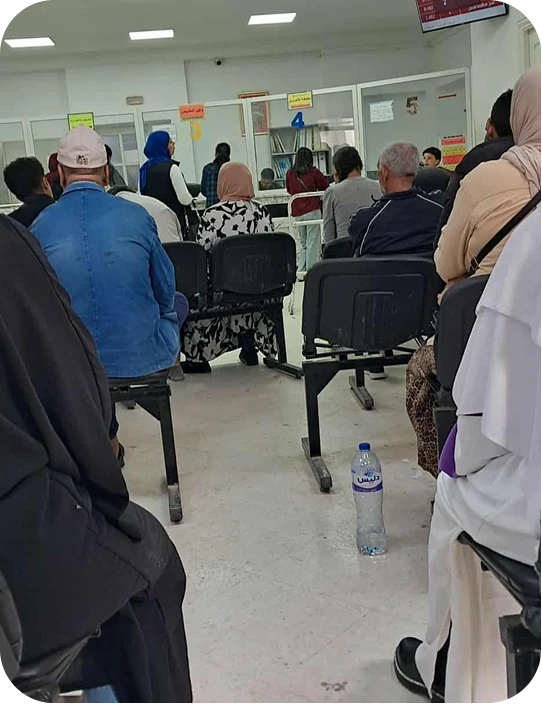
Students and parents dealing with grant paperwork, and the agents serving them.
Where & when
Mnihla municipality, Ariana, on 27/10/2025, and student Facebook groups on 25–26/10/2025.
Method
Passive and participant observation, including my own scholarship file.
What I saw in the field
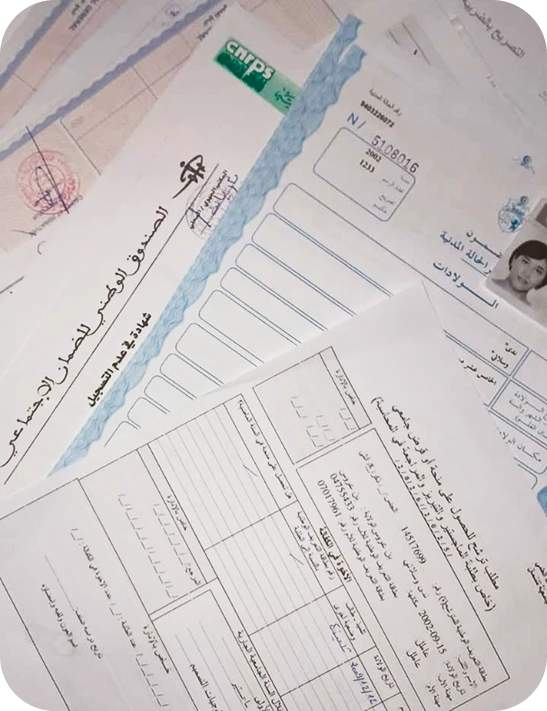
A full waiting room for paperwork that could be a form. A pile of certificates from offices that don't talk to each other.
And in the Facebook groups: "I sent my file over a month ago and they still tell me it hasn't been processed. I need the money like any other student."
Administrative domino effect
Agents give conflicting answers
Exhausted parents
Stressed students
Social media, the only clear source
Step 5 · Interviews
3 semi-structured interviews with students at three different points of the process.
Master's student
Back from a mobility exchange
10 min
Master's student
Local path
15 min
PhD candidate
Renewing her grant
35 min
The current process is absolute chaos. I live a toxic relationship with it.
An ideal system should tell me clearly what to do. I don't want to search for the information alone.
I was a young, lost student facing a system too complicated and without warmth. I'd have loved a kind interface that helps me, one step at a time.
Step 6 · Survey · quantitative data
A Google Forms survey ran for two weeks to validate the scale of the problem.
32
Respondents
76%
find the procedures complex
86%
feel physically overloaded
69%
want a fully digital process
52%
want real-time tracking
Current problemsExpectations & needs
The real problem
The current process is slow, opaque and not digital. Steps pile up, answers come late, and trust runs out before the journey even ends.
User journey · getting the annual grant
Ghada Mejri
20 · Bachelor's student, Tunis · depends on her grant for tuition
"It's too complicated, I'm sure I'll make a mistake."
From searching for information to cashing the money. Goal: get the grant on time, without stress or useless trips, with clear follow-up.
Stage
1Application
2Collecting papers
3Posting the file
4Processing
5Results
6Payment
Actions
Finds the official link, fills in the form
Goes from office to office for documents
Sends the complete paper file by post
Waits for days with no update
Checks again and again if results are out
Travels to cash the transfer
Touchpoints
Social media → website
Public offices, printer
La Poste
Nothing
Facebook groups
SMS, D17 account, La Poste
Pain points
Link hard to find, one-shot form, bugs
Many trips, lost time, unconnected services
Extra trip, risk of loss or delay
No notification, no status
A single page, link not found
Frequent delays, yet another trip
Emotion
😤Frustration
😮💨Exhaustion
😟Worry
😰Peak stress
😌Brief relief
⏳Impatience
Opportunity
Centralisation: one stable national portal
Digital filing: e-signature and uploads
Paperless: inter-office verification
Transparency: live tracking with progress
Reliable comms: official, personal notification
Direct payment: automatic, on a fixed date
Scroll sideways on smaller screens.
Towards a solution
1Centralise and simplify the process
2Total transparency and proactive tracking
3Accessibility and human support
Design & Solution
Four promises. Never leave a student guessing.
Know what to submit
A clear checklist with a status for each file, so one missing paper can’t silently block everything.
Real-time tracking
Submitted, under review, decision: a visible progression replacing the silence that sent students to Facebook.
One secure entry point
A single national portal and one simple identification flow for the whole service.
Moments of reassurance
Confirmations, clear next steps and human support at the moments students felt most anxious.
Key screens
Six screens, one journey without guessing.
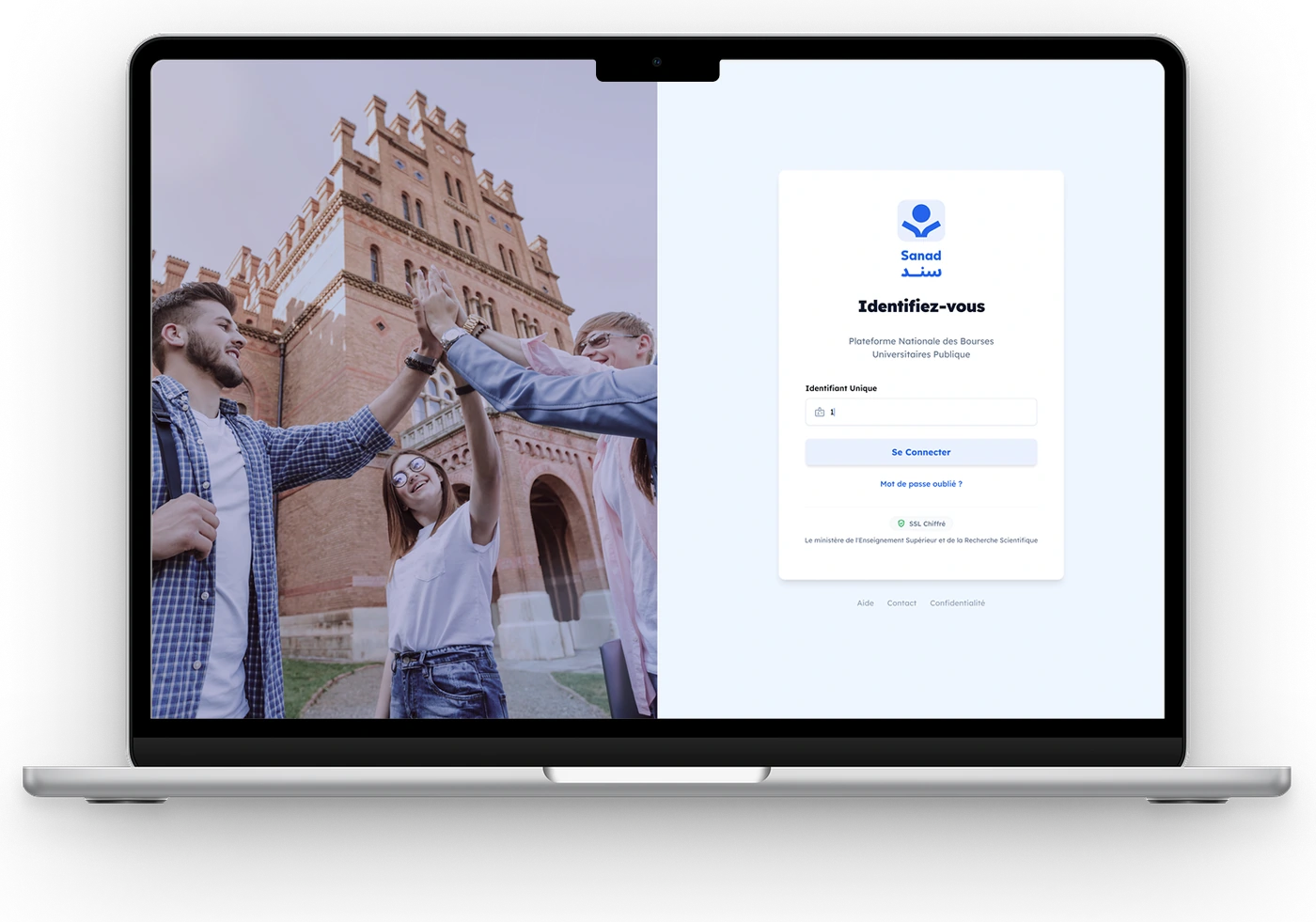
01
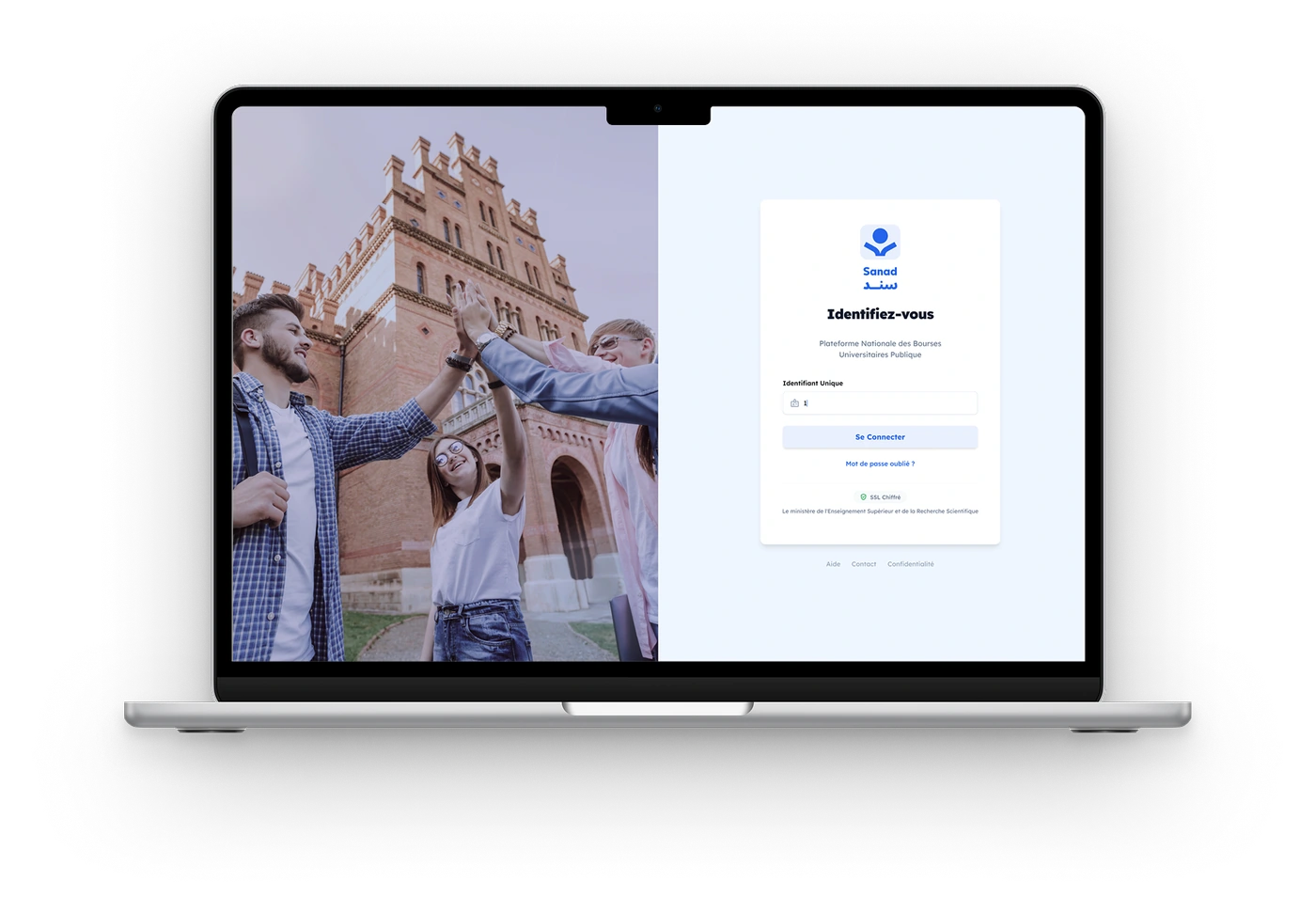
One secure entry point
A single national login with a unique student ID.
Why it mattersNo more hunting for the right link on Facebook: one official door for every student.
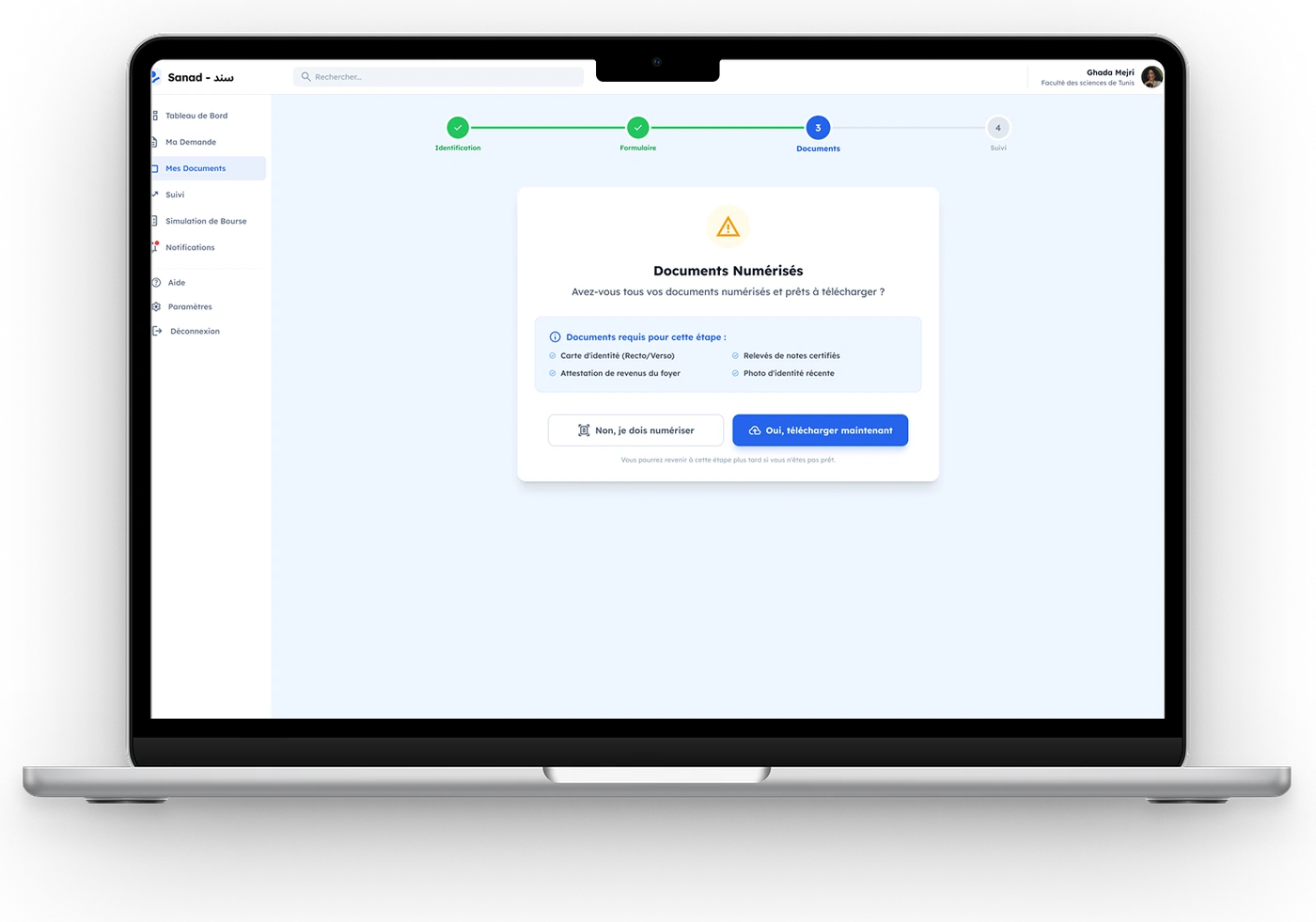
02
Check before you start
Lists the papers needed and asks if they are ready.
Why it mattersGhada feared making a mistake. Knowing upfront avoids a rejected file weeks later.
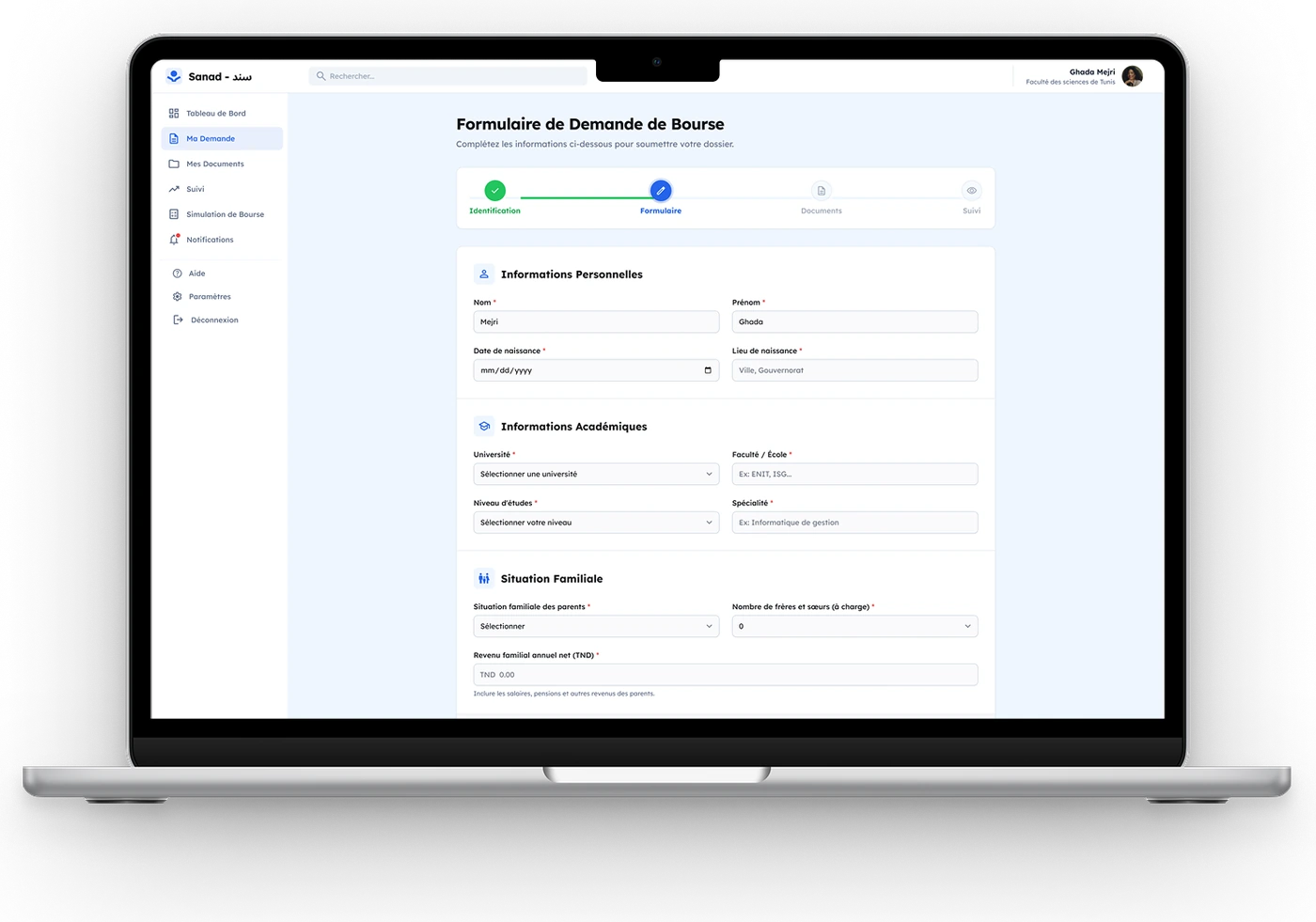
03
A guided application form
Personal, academic and family info, step by step with a progress bar.
Why it mattersSmall steps and clear labels make a heavy procedure feel manageable.
04
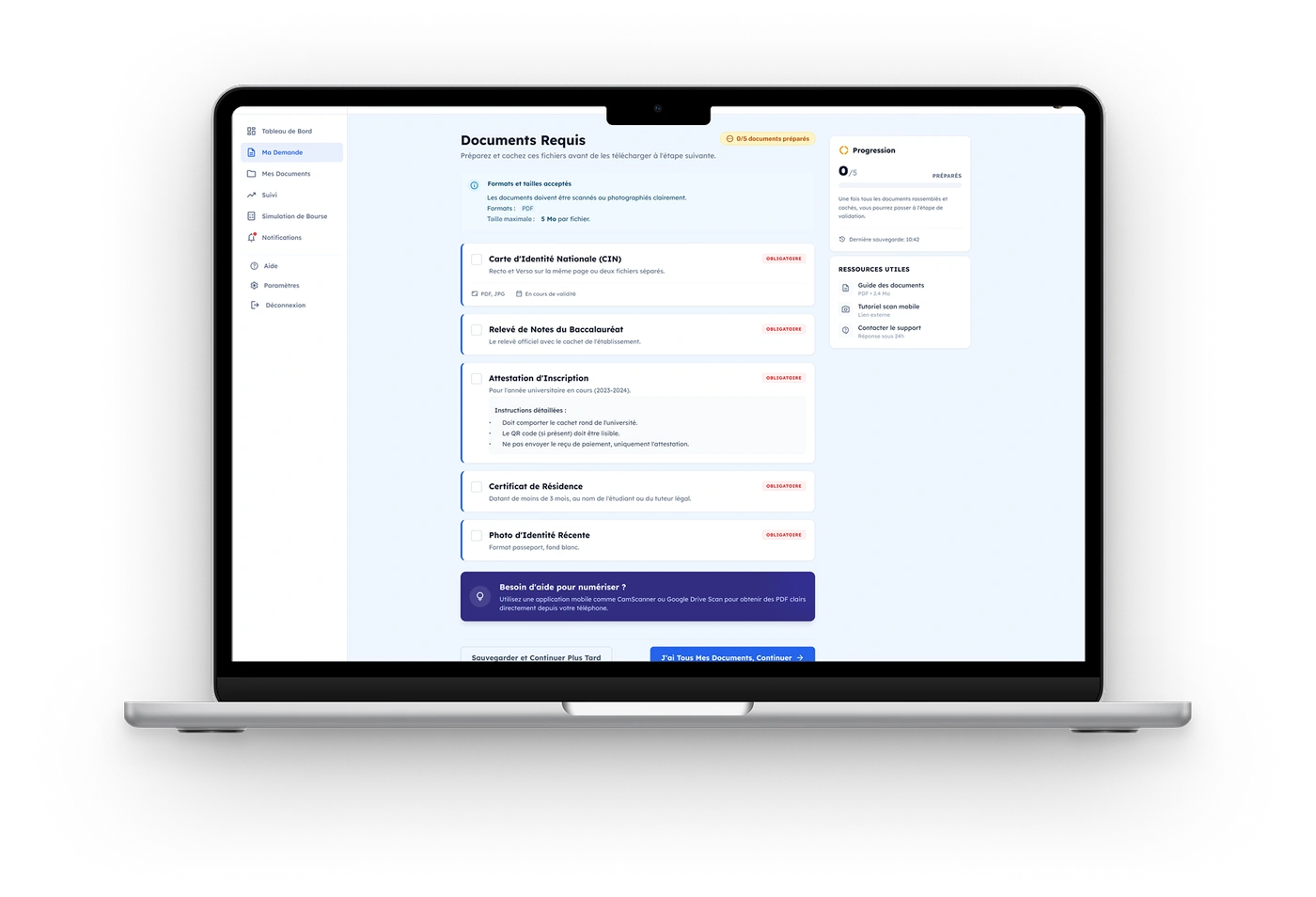
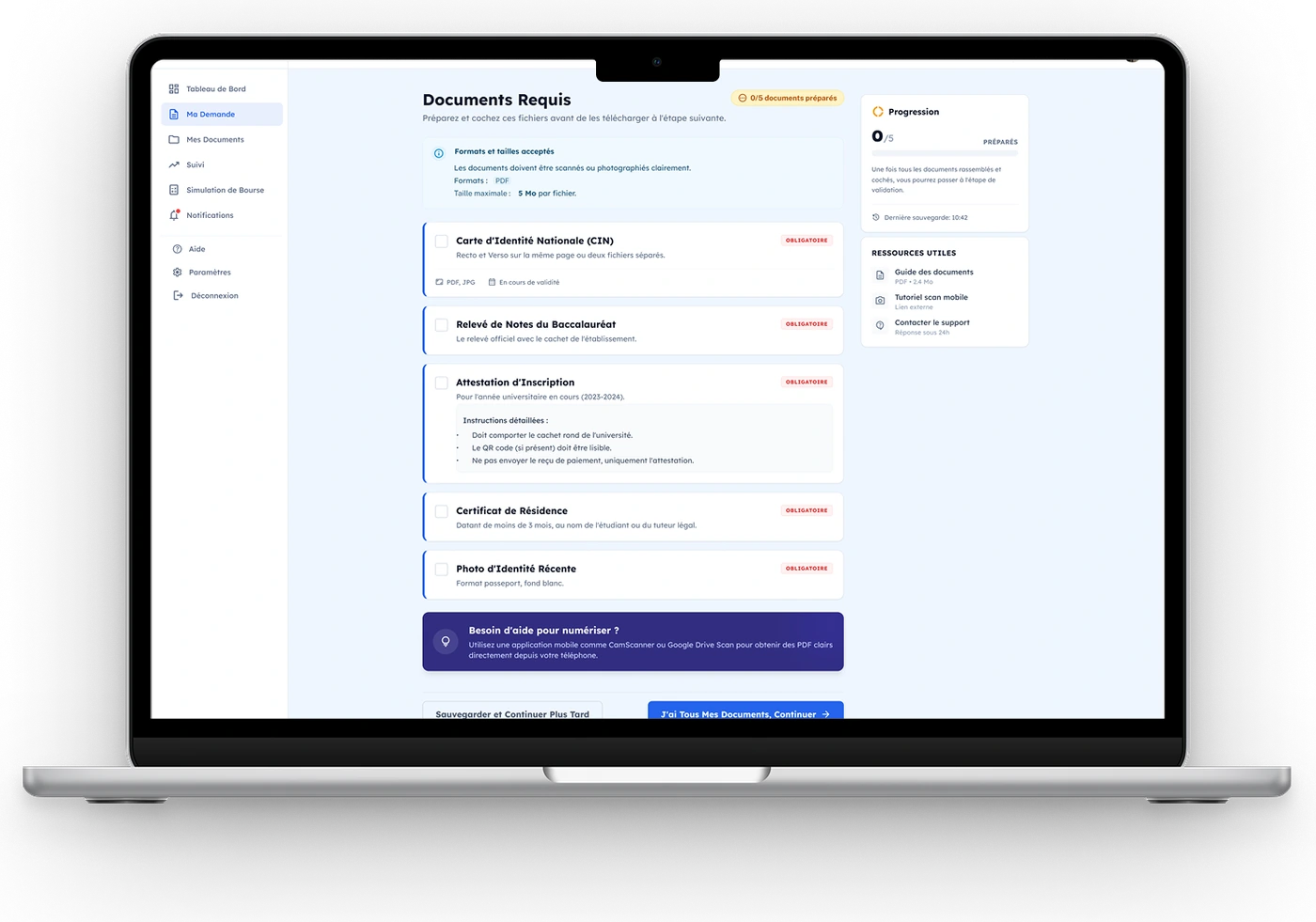
Required documents, explained
Each paper with its format, status and instructions.
Why it mattersOne missing document used to block everything in silence. Now it is visible.
05
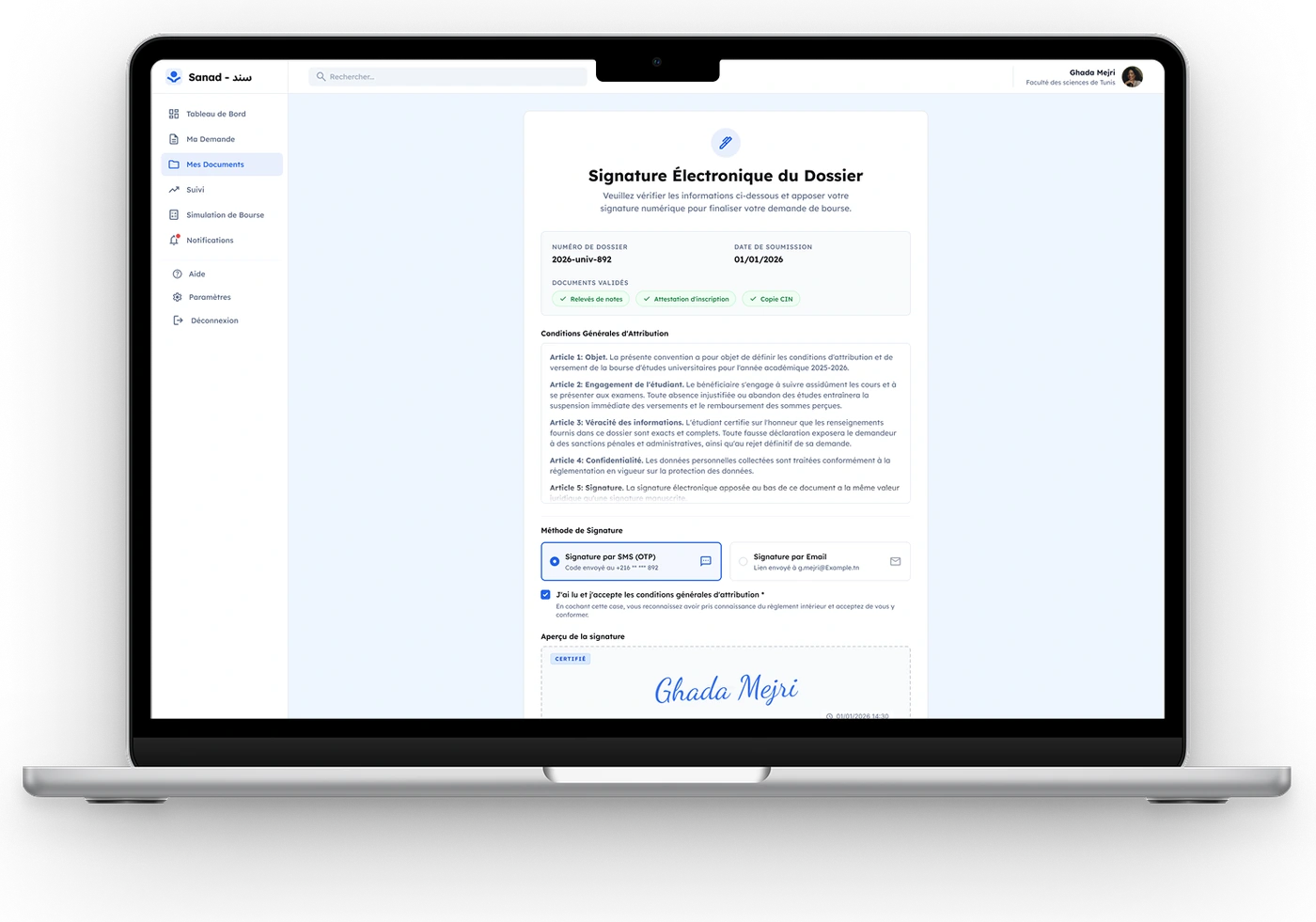
Electronic signature
Sign the file by SMS or email, no trip, no post.
Why it mattersRemoves the posting step: no extra travel, no risk of loss.
06
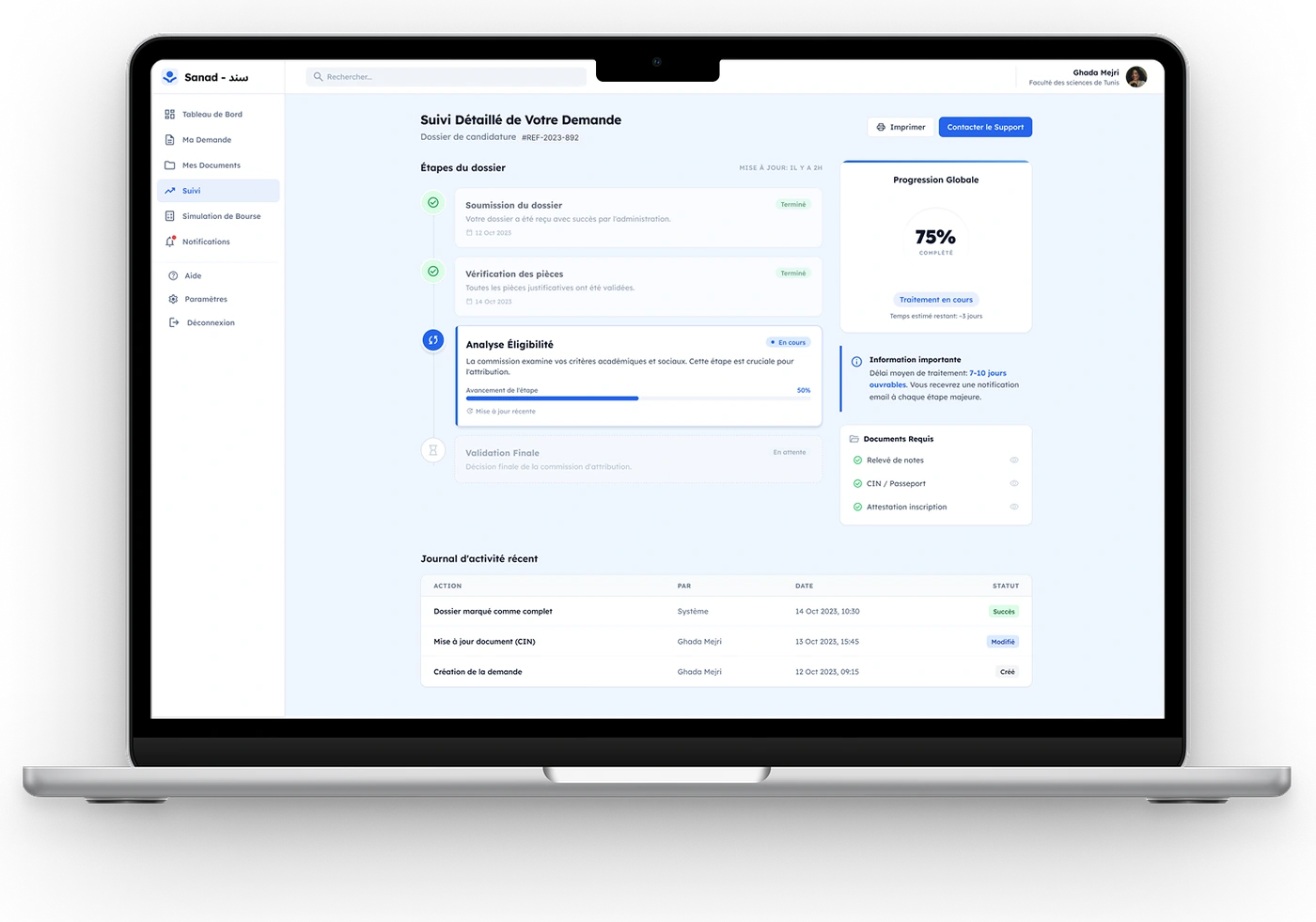
Real-time tracking
Every stage, a progress score and an activity log.
Why it mattersThe answer to "Did my file go through?", always one glance away.
Prototype
The prototype, in motion.
Outcome & Reflection
A process students feared. Now one they can follow.
A high-fidelity platform that turns a fragmented, semi-digital procedure into one transparent service, built with the students who live it every year.
The biggest lesson was the pivot itself: the problem you're given is rarely the problem you need to solve.
What I'd take further
→Usability testing of the tracking flow during a real application period.
→A parent mode, since many parents help with the paperwork.
→An agent dashboard for the offices still processing files by hand.